PREAMBLE
So this was sort of inspired by @caethyril and @bgillisp unintentionally. They aren't aware of the thoughts they planted in my head.It started when bg was showing a screenshot of Theme6 in Audacity and I was surprised to see that the wave form had quite a few peaks and valleys. For such a loud song I would have expected more of a square wave.
Then something caethyril had shared before clicked in my head. She had shared a plugin that involves a compressor built into NWJS. So it dawned on me: What if the compressor is applying some sort of excessive make-up gain after gain reduction? make-up gain is pretty common in most modern compressors, so wouldn't be surprising if they just used an existing compressor library as the base of their compressor code.
The only way to tell is to compare wave forms from the original Theme6 ogg file and the output Theme6 when launching a new project game.
Come a long friends while we walk the path to no where.
TEST 1, Loudness Matching
So my first attempt was sort of bunk. I didn't realize that my system volume mixer (at the OS level) was turned down for RM games, so the resulting recording was quite a bit quieter than the regular OGG.
However, at first I didn't consider that fact and so I just decided to try to match the ogg's volume with captured audio's volume. So I turned up the game version and turned down the ogg version until measurements matched as close as I could get on perceived volume, then rendered them out as new wavs and then compared the wav form and measured their loudness.
The results are...inconclusive.
You'll need to zoom in the picture, but you can see my loudness analyzers and the results they got. The top is the game audio and the bottom is the ogg audio.
SIDE QUEST: Loudness is weird
Some of you may not understand loudness. Like you know when a sound is loud, and maybe you know we measure sounds in decibels (dB ), but the truth is that dB are sort of misleading. The subject of perceived loudness is complicated and I am not qualified to explain it, but it involves a lot of psychology, physics, and the shapes of our ears, but basically dB are not a reliable way to measure volume, which is why LUFs (Loudness units relative to full scale) became a standard measurement of perceived loudness.
So just a reminder: true loudness is not the same a perceived loudness.
Basically all you need to know is that the higher the number is for LUFs, the louder the perceived loudness is.
Setting a Baseline: What constitutes "Loud" and "not loud"?
So it may be hard to get a sense of what we are talking about when it comes to "RPG Maker is loud".So, in order to establish a baseline, as well as see what other engines/developers are targeting for their volume, I sampled 8 different games. Actually there was an interesting discovery I'll talk about as we go through these games.
Before jumping in, let me explain how this test was set up and what I am comparing.
- I would play each of these games for roughly 20 minutes while recording. I recorded everything at max volume (I double checked sliders too to ensure everything is at 100%).
- I would then take the audio track of the recording and trim it down to the loudest section of the game (based on wave form). This section would typically be roughly 40 seconds to 1 minute in length.
- I would then compare this sample of game play audio against Theme6. To ensure measurements averaged out properly, I would let the whole sample play through in length. The screenshots of loudness measures are at the start of the second loop of the play back, so all averages should be accounted for in the measurements.
Loudness Baseline Games
"Why were these games selected?"
There isn't much throught, other than ensuring a diversity in games. Some of these games (such as Kunitsu-gami) have been selected simply because it was already installed on my computer. But, I tried to pick games with diverse soundscapes, of varying levels of budgets, and using different engines. To be clear, mixing is hardly an engine dependent thing, other than maybe offering more out-of-the-box tools to improve mixes. But things can be loud on any engine - as we will see soon enough.
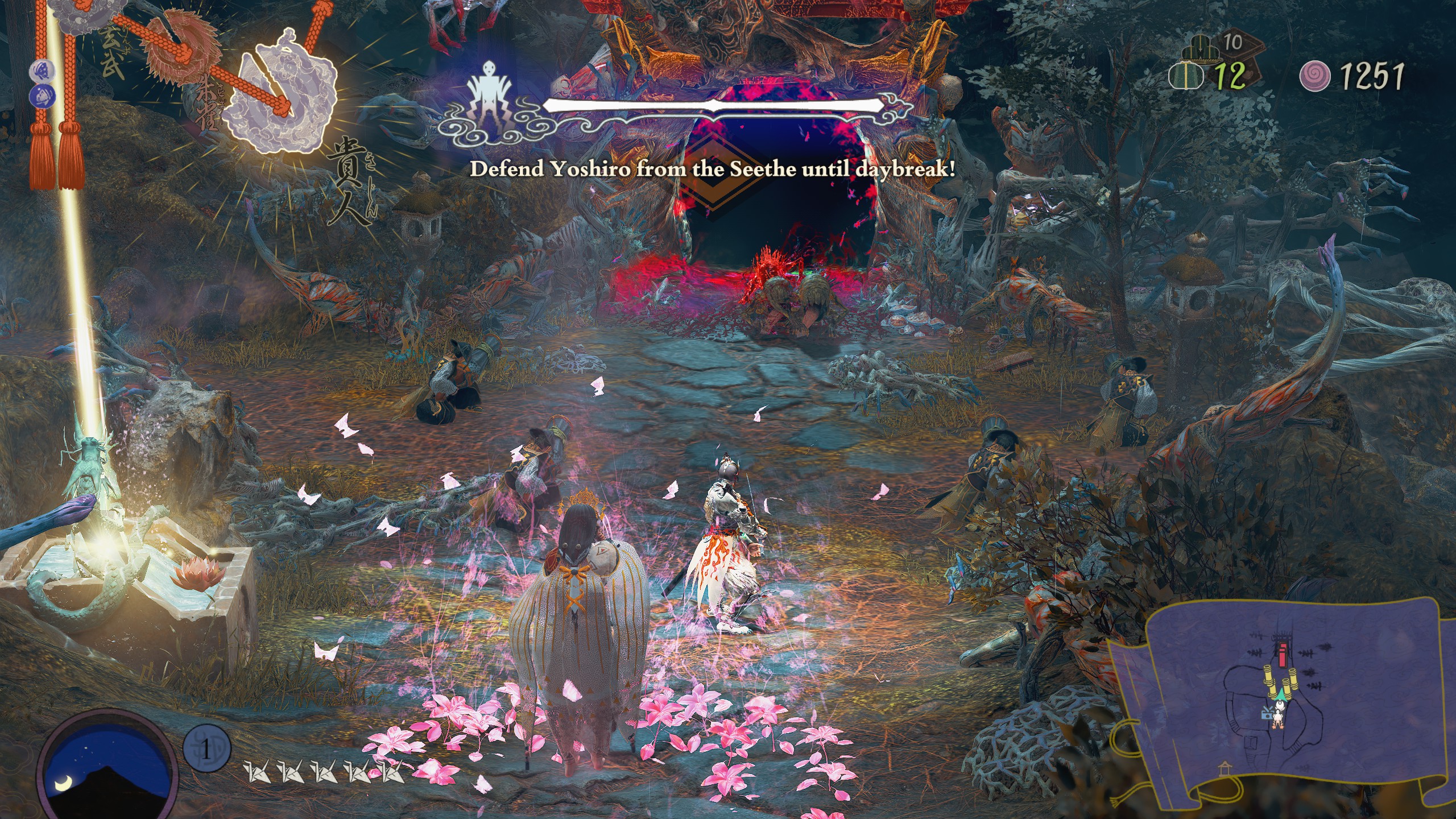
We're starting with Kunitsu-gami because it sort of has the opposite problem of RM in that it is incredibly quiet. When I was just playing in my own free time, I would often have to crank all of my volume sliders and knobs up to get a comfortable listening experience for this game. Let's check the measures so you can see that quiet wave form!
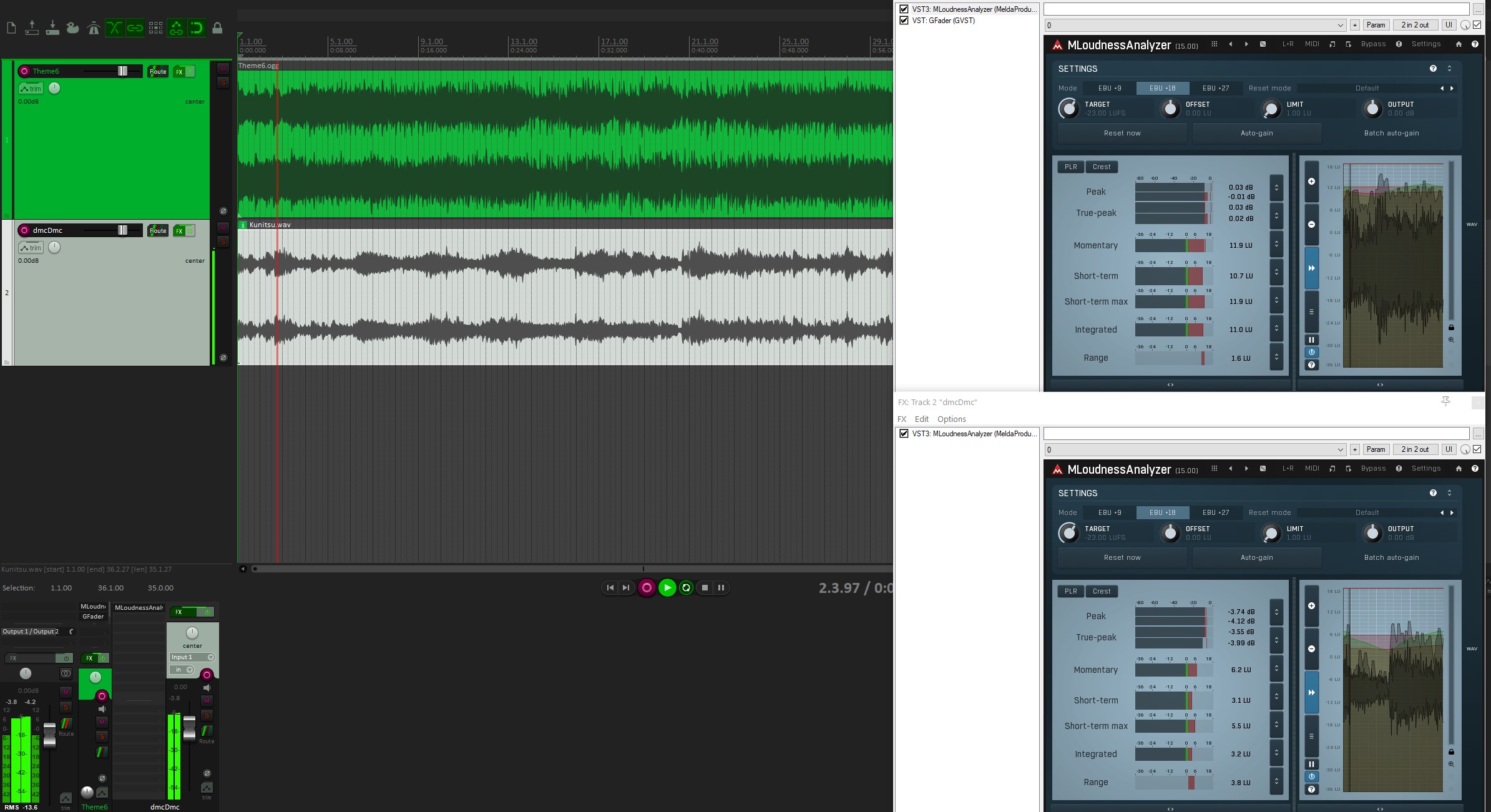
Theme6 is on the top, of course, and Kunitsu-gami is on the bottom. Now would be an appropriate time to remind you that the audio sample comes from the loudest point in my game play session.
With the short term average being just 3.1 LUFs, it is an astounding 8 LUFs quieter than Theme6.
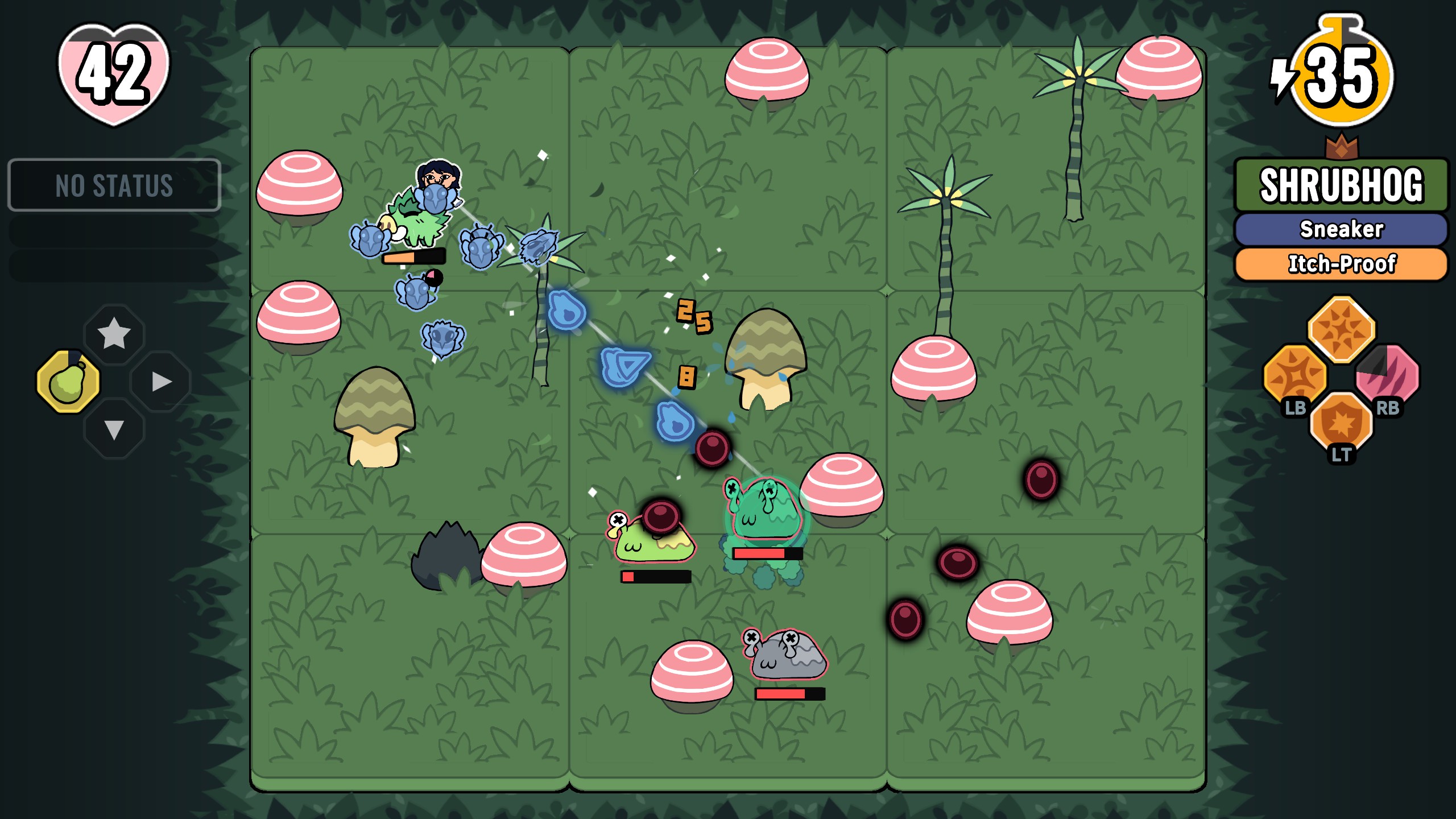
The sound design isn't particularly remarkable in this game, but I find it's volume and use of dynamics very cozy, as even during it's most busiest of combat encounters, it doesn't feel like the soundstage is getting overwhelmed with music and sound effects. I believe this has to do with it's generous headroom in the mix, allowing for quite dynamic audio output. Let's see those measurements.
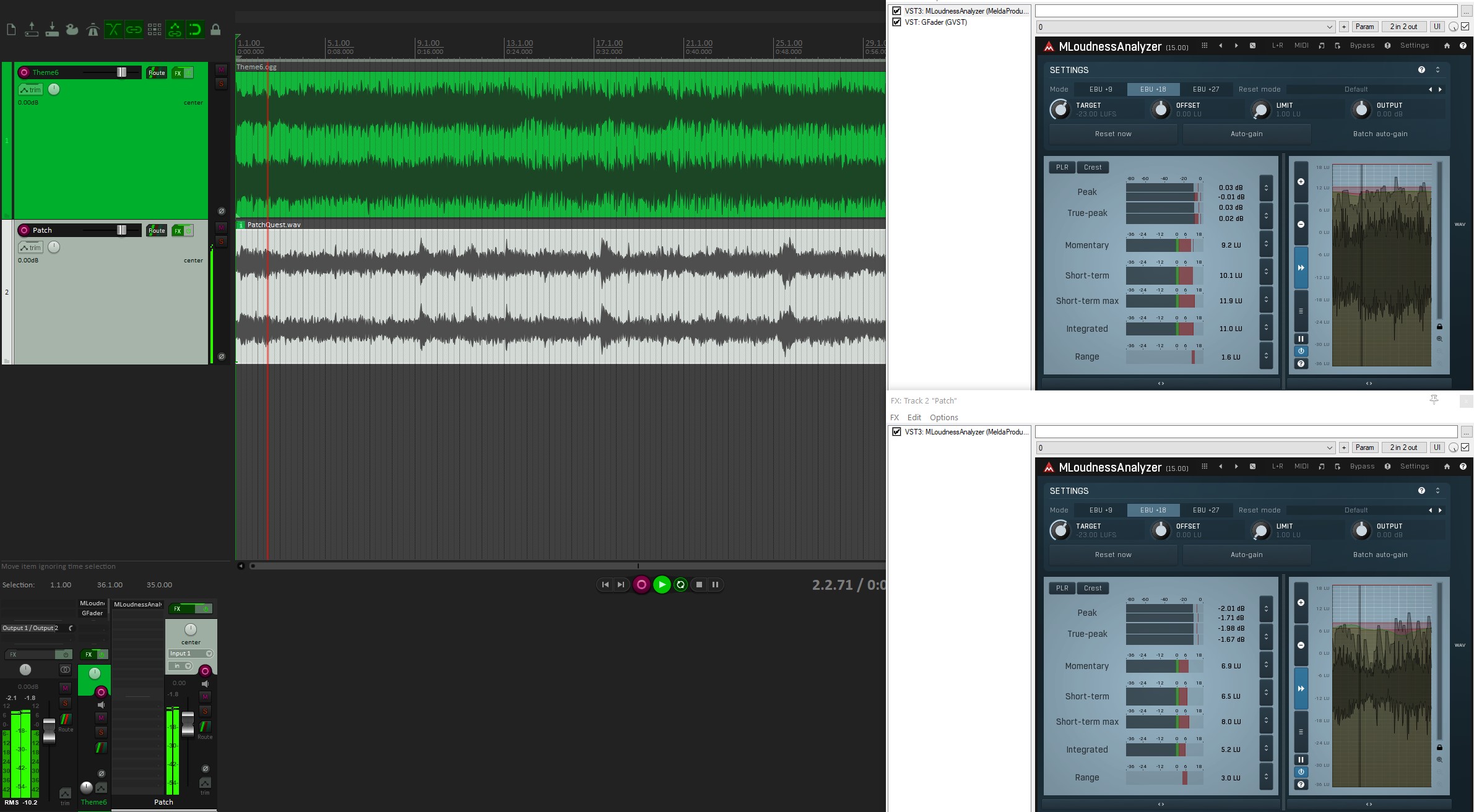
With the short term average being 6.5 LUFs, it is 3.5 LUFs quieter than Theme6. You can see lots of various peaks in the audio, which are the dynamics I spoke about. Even at the loudest peaks there is still about a 3dB of headroom before reaching peak (true) loudness.
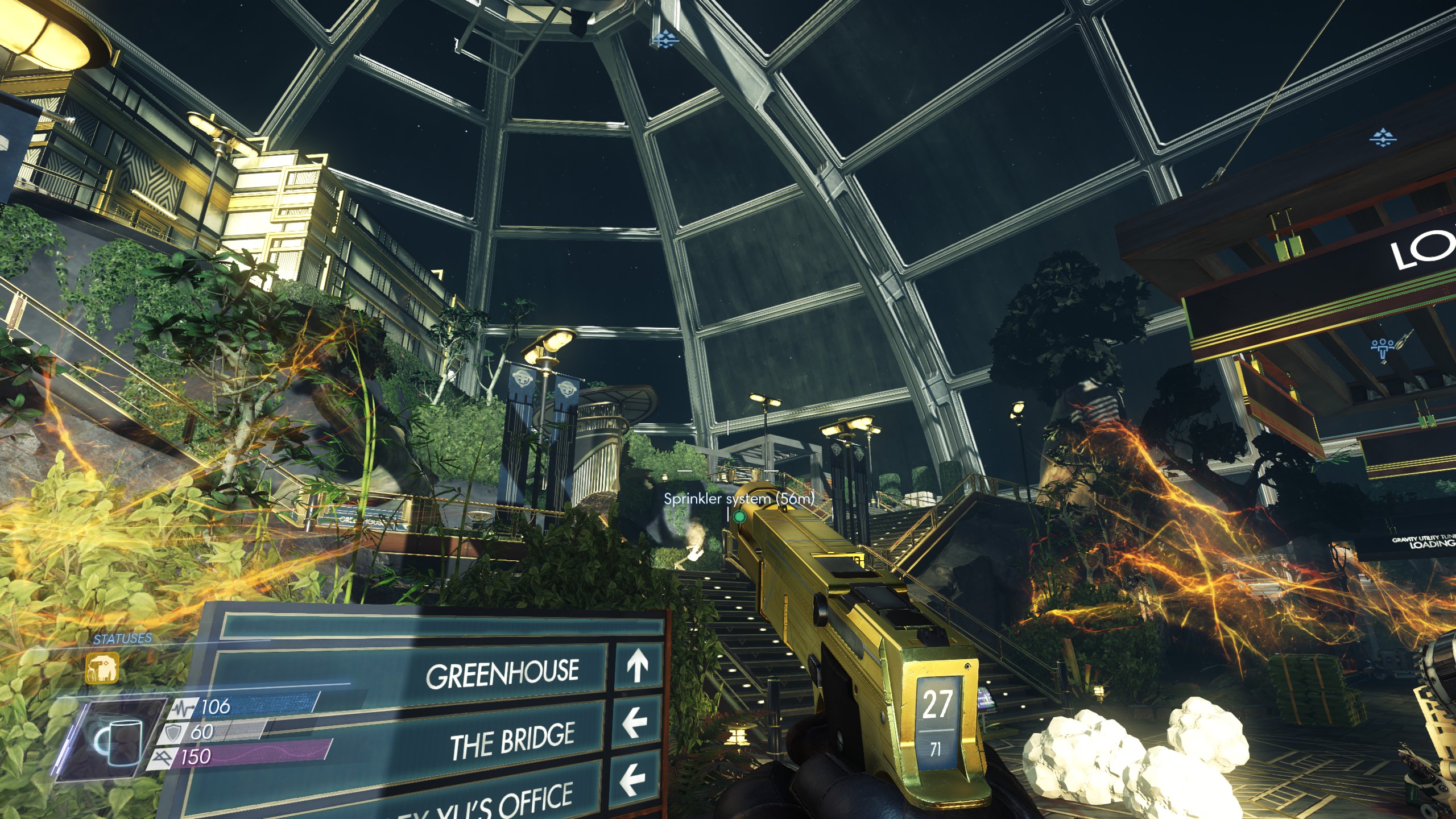
Prey is sort of hard to compare, because when we talk dynamics, this game is REALLY dynamic. Perhaps an interesting discussion in game design for another topic, but the enemy encounters are very few and far between, and can be over rather quickly. This game has A LOT of "quiet time", and to be honest, I really love this. It really creates quite a contrast in the game flow. But the challenge here is that the average short-term is not a good point of comparison. Let's look at the measurements and talk about it.
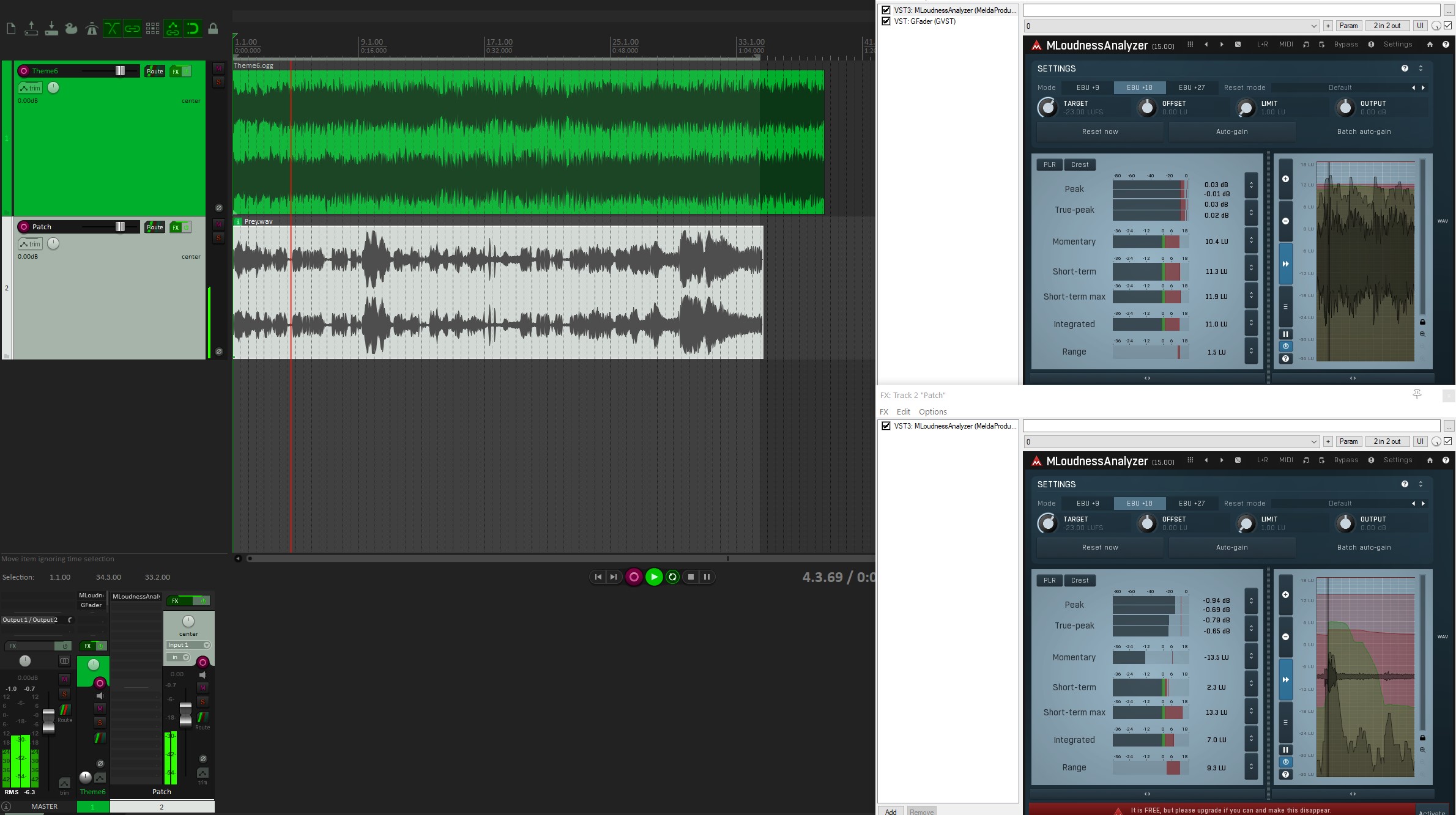
You can see there is a lot of quiet time in this game. In fact it's even quieter than this often times. Once again, we are looking at the loudest section of game play. It's only this loud because a character is talking over the radio in this portion of the game. While they are talking I get into a firefight, which eventually results in my taking a careless step into an oxygen tank which the enemy blows up. That is the really loud section of the waveform you see at the very end of the sample. Here we probably want to look at the short-term max, which is the max peak measured over a term.
At 13.3 LUFs, this shows how dynamic the game really can be, as not even Theme6 with it's exciting (and clipping) "BWHAAA" at the very start of the game is as loud as the explosion that killed me in the game play sample. An interesting point to look at is the "range" measurement. The red highlighted area shows an average range of volume, which, when compared to Theme6 is quite wide.
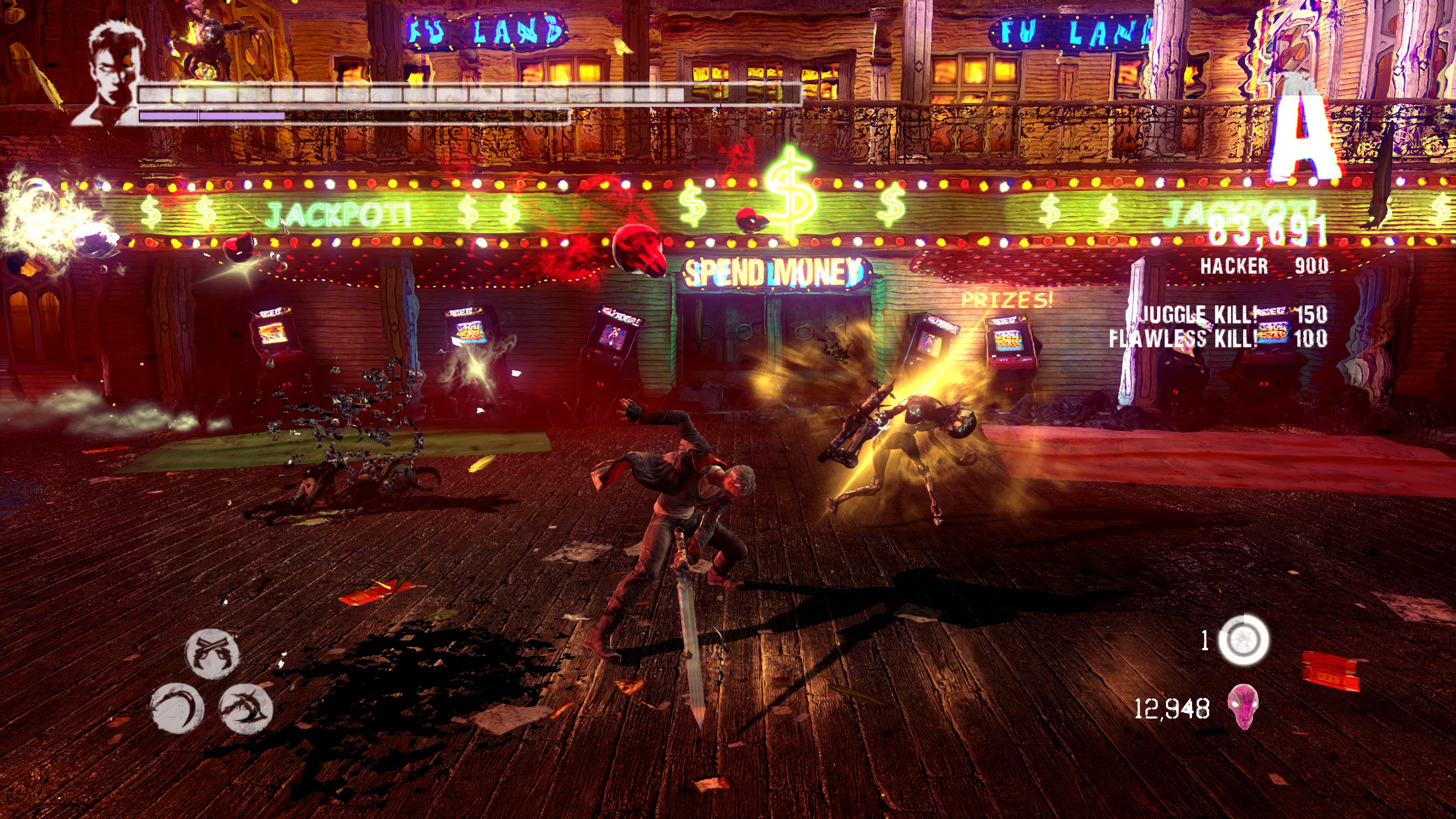
DmC: DMC is where I start to consider games reaching "loud". With a bumping soundtrack by Combichrist - an Industrial Metal band - and Noisia - an EDM and dubstep artist - and high octane action, it's understandable this game tends to be noisier than the previous games we checked. But how much so?
Warframe is another interesting one because, prior to testing, I sort of assumed it would be a much quieter game...and then I saw the measurements. You'll see that in just a sec. But what I think this goes to show is that loudness doesn't account for everything. Just because you have dynamics and your audio isn't super loud, doesn't mean it's still not going to be uncomfortable for people to listen to.
DOOM shares a similar picture as Warframe, in that the game is actually louder than Theme6, but is far more comfortable to listen to. Part this has to do with sidechaining the different audio channels to help make the overall mix feel tighter, and without having audio track fight for the same headroom.
What is side-chaining you ask? Well, it's when you use the output of one audio track to control the effect on another audio track. Most commonly this is used on compressors where the gain reduction is controlled by a separate input. The result is that the audio "ducks" out of the way when that other audio track reaches a certain volume. So in a way, audio track A is "clearing the way" for audio track B so that track B can be more audible.
Both Warframe and DOOM utilize a lot of sidechained audio in their mixes. This allows you to create a fake sense of "dynamics" by reducing the volume of another thing so that another thing can cut through the audio mix, it makes that other thing seem louder than it is, without actually making it loud.
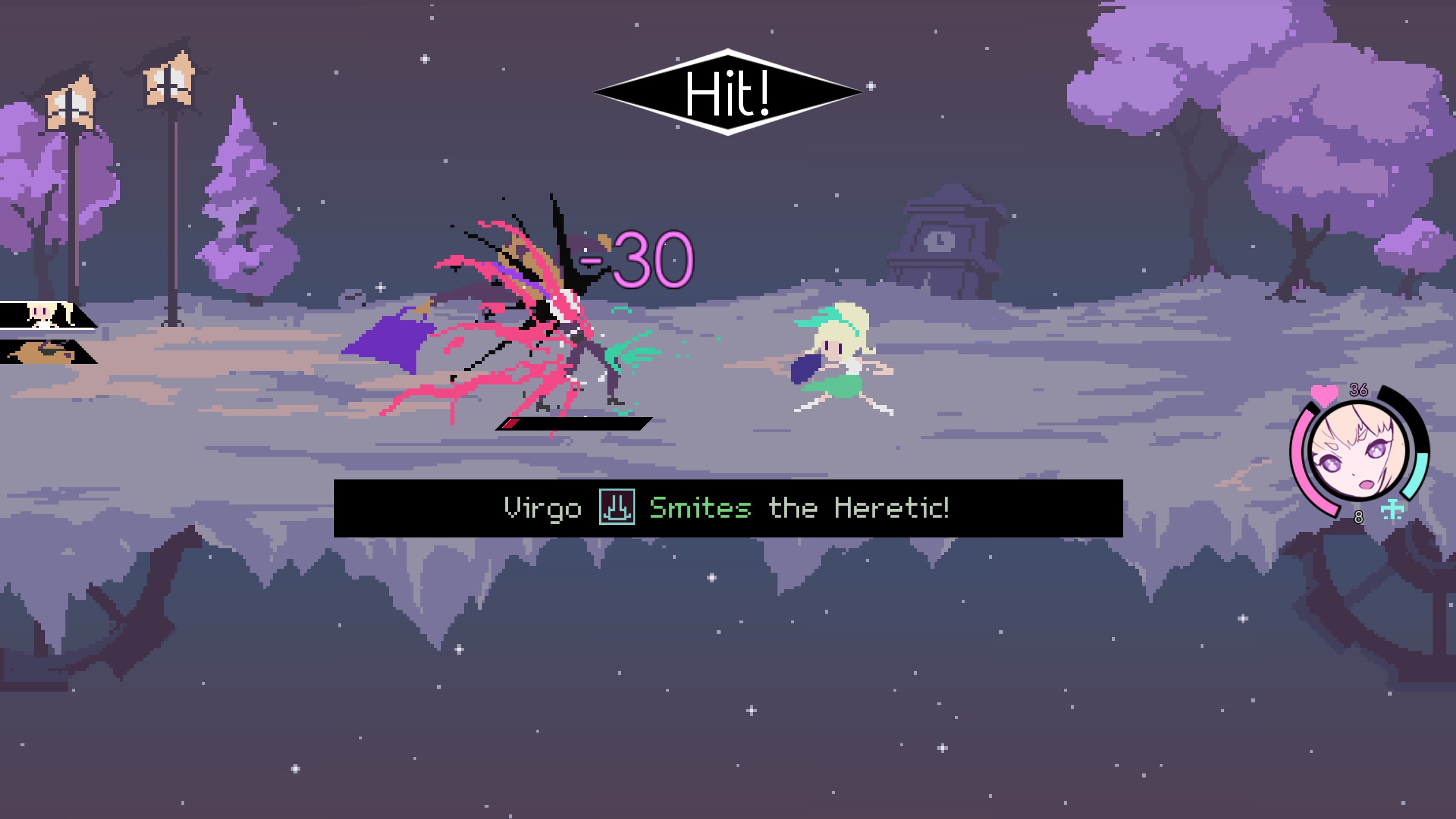
OOOOOOF, this game. Compression at maximum, dynamic range at 0. I picked this game because I distinctly remember really hating the mixing on an individual level of the soundtrack music, but also broadly speaking for the whole game as well. There also plenty of other reasons I really despised this game. But I'm not here to review games, just here to talk about loudness comparisons.
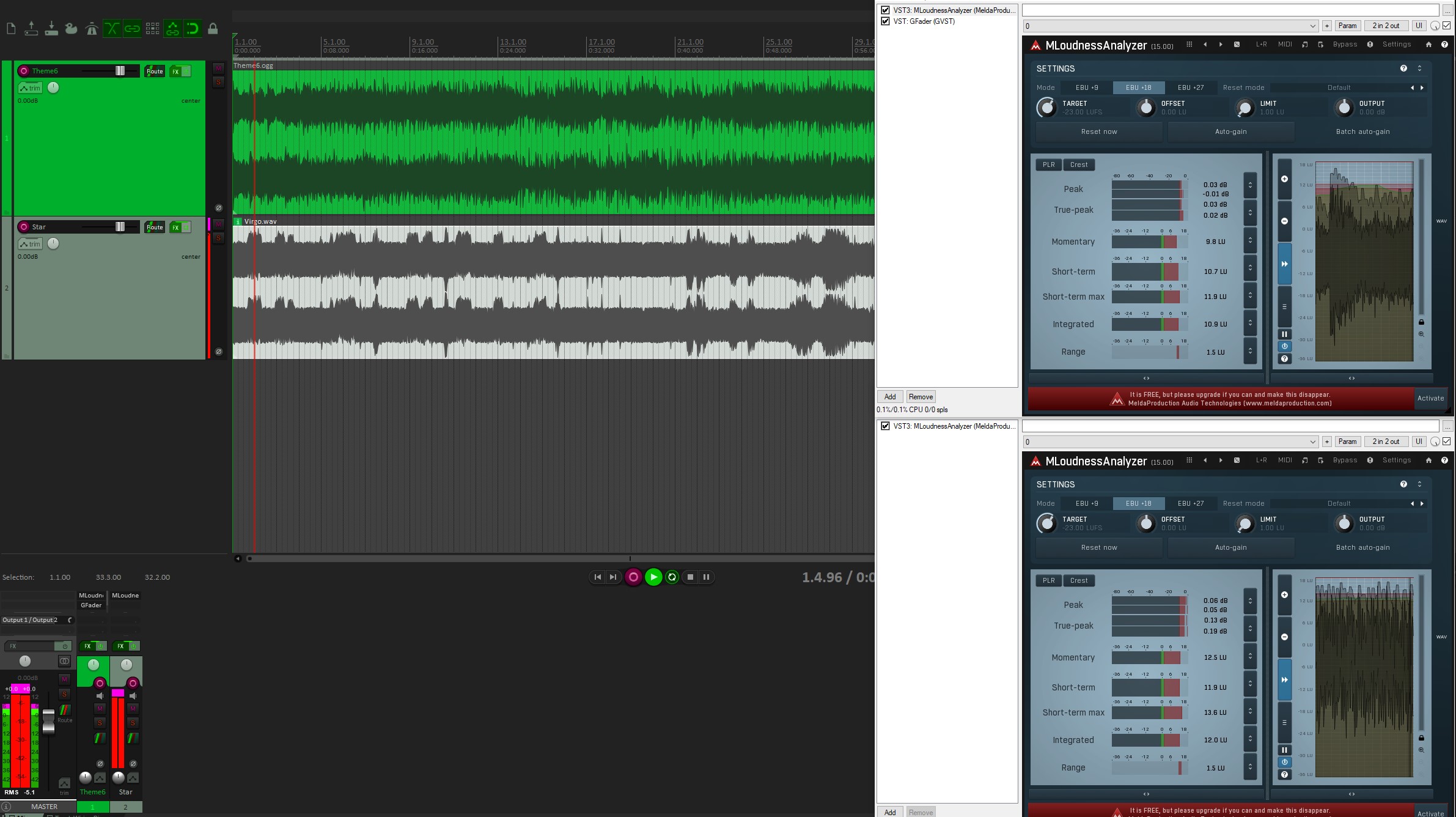
Hopefully after looking at so many volume comparisons throughout this section, you immediately notice something is a bit off here. Even if you aren't musically trained, you notice that there appears to be a long brick wall going through the wave form. The soundtrack to this game has been so overly compressed that it feels like it's right in front of your face screaming at you. It is an exhausting thing to listen to.
And the loudness measurements go to show that. at 11.9 LUFs, it is louder than Theme6, but it is far, far more exhausting to listen to than Theme6.
Also, major clipping problems from this game.
It's a real shame, because the CG art and illustrations really sold me on a different impression of the game that made me really want to like this game, but beyond the horrendous mixing, there are a number of fundamental flaws with the game design itself. Again, not here to review though.
The game is a small indie project released for free on Steam recently. The reason I picked this game was...well it was convenient. I had already installed it because I was going to play this game on stream.
So, I applaud the solo effort, but this one is just here to go to show you: let's be thankful for the built in NWJS compressor.
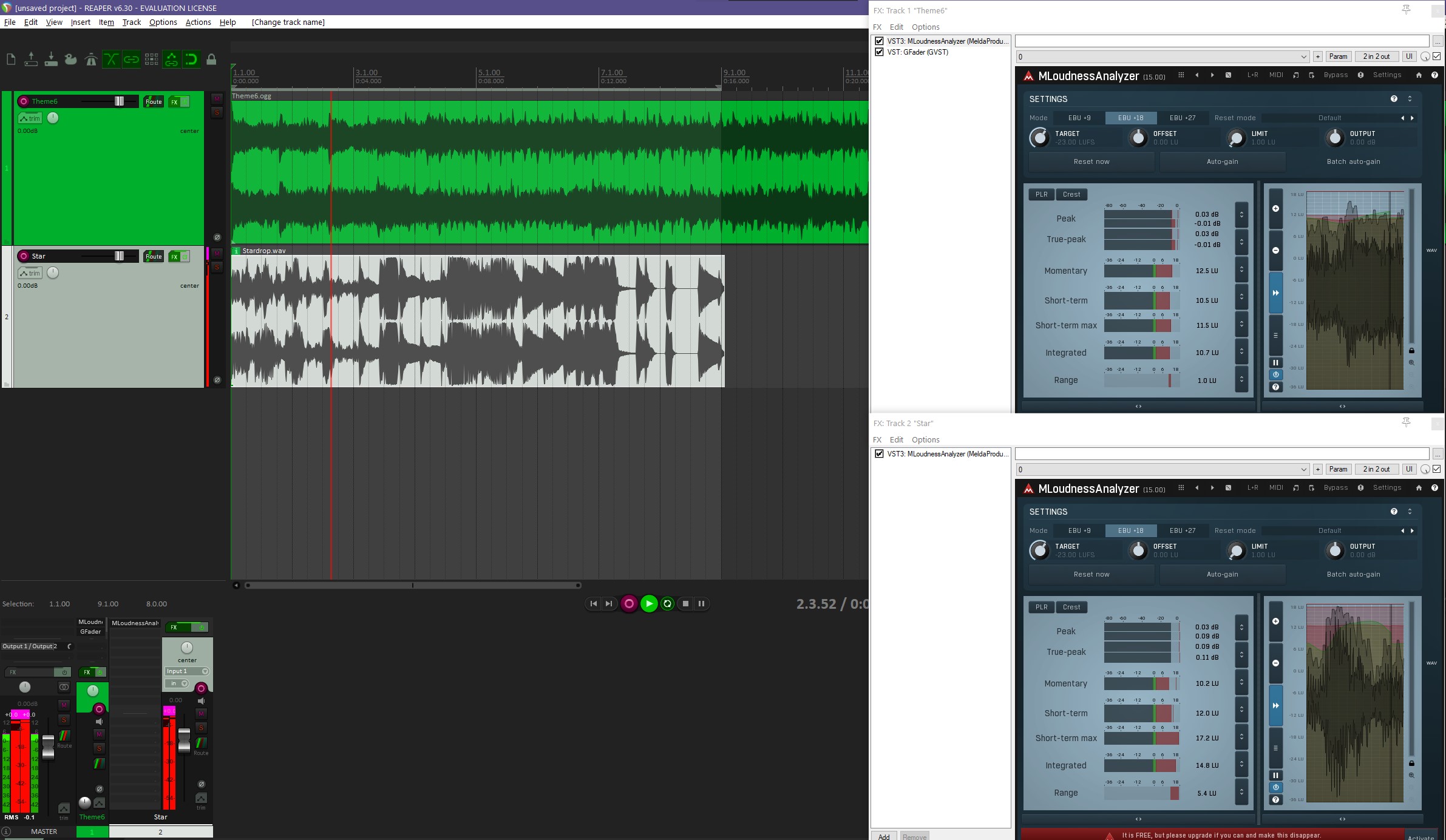
Nearly every single sound in this game clips, which causes distortion, which causes fatigue on the ears, making it an exhausting listen...almost as much as Virgo.
Out of all games featured here, it has had the loudest peak in the short-term max, at 17.2 LUFs. Yeesh.
There isn't much throught, other than ensuring a diversity in games. Some of these games (such as Kunitsu-gami) have been selected simply because it was already installed on my computer. But, I tried to pick games with diverse soundscapes, of varying levels of budgets, and using different engines. To be clear, mixing is hardly an engine dependent thing, other than maybe offering more out-of-the-box tools to improve mixes. But things can be loud on any engine - as we will see soon enough.
1. Kunitsu-gami: Path of the Goddess - Capcom, RE:engine
We're starting with Kunitsu-gami because it sort of has the opposite problem of RM in that it is incredibly quiet. When I was just playing in my own free time, I would often have to crank all of my volume sliders and knobs up to get a comfortable listening experience for this game. Let's check the measures so you can see that quiet wave form!
Theme6 is on the top, of course, and Kunitsu-gami is on the bottom. Now would be an appropriate time to remind you that the audio sample comes from the loudest point in my game play session.
With the short term average being just 3.1 LUFs, it is an astounding 8 LUFs quieter than Theme6.
2. Patch Quest - Lemon, Unity Engine
The sound design isn't particularly remarkable in this game, but I find it's volume and use of dynamics very cozy, as even during it's most busiest of combat encounters, it doesn't feel like the soundstage is getting overwhelmed with music and sound effects. I believe this has to do with it's generous headroom in the mix, allowing for quite dynamic audio output. Let's see those measurements.
With the short term average being 6.5 LUFs, it is 3.5 LUFs quieter than Theme6. You can see lots of various peaks in the audio, which are the dynamics I spoke about. Even at the loudest peaks there is still about a 3dB of headroom before reaching peak (true) loudness.
3. Prey (2017) - Arcane Studios, CryEngine
Prey is sort of hard to compare, because when we talk dynamics, this game is REALLY dynamic. Perhaps an interesting discussion in game design for another topic, but the enemy encounters are very few and far between, and can be over rather quickly. This game has A LOT of "quiet time", and to be honest, I really love this. It really creates quite a contrast in the game flow. But the challenge here is that the average short-term is not a good point of comparison. Let's look at the measurements and talk about it.
You can see there is a lot of quiet time in this game. In fact it's even quieter than this often times. Once again, we are looking at the loudest section of game play. It's only this loud because a character is talking over the radio in this portion of the game. While they are talking I get into a firefight, which eventually results in my taking a careless step into an oxygen tank which the enemy blows up. That is the really loud section of the waveform you see at the very end of the sample. Here we probably want to look at the short-term max, which is the max peak measured over a term.
At 13.3 LUFs, this shows how dynamic the game really can be, as not even Theme6 with it's exciting (and clipping) "BWHAAA" at the very start of the game is as loud as the explosion that killed me in the game play sample. An interesting point to look at is the "range" measurement. The red highlighted area shows an average range of volume, which, when compared to Theme6 is quite wide.
4. DmC: Devil May Cry - Ninja Theory, Unreal Engine 3
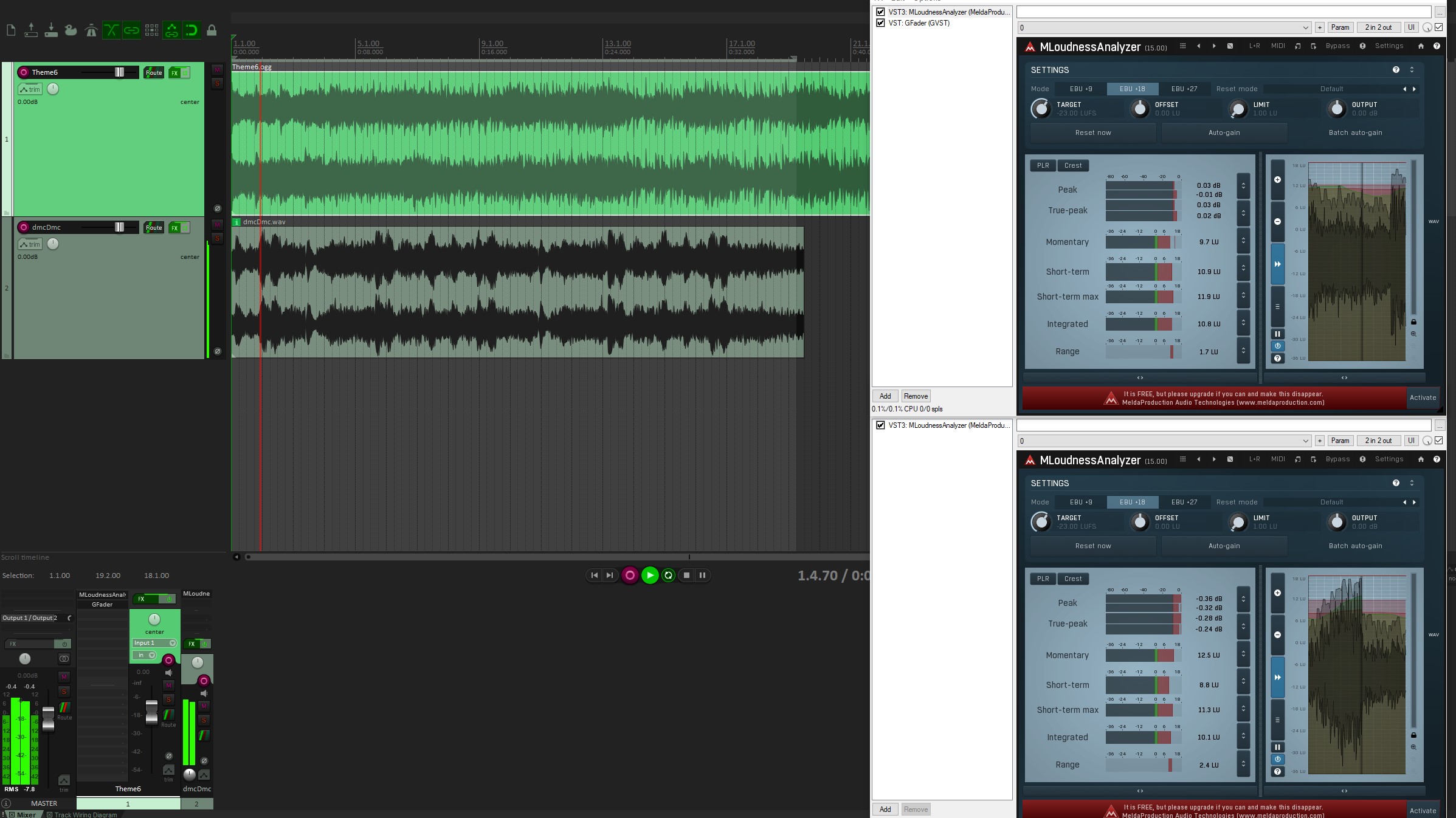
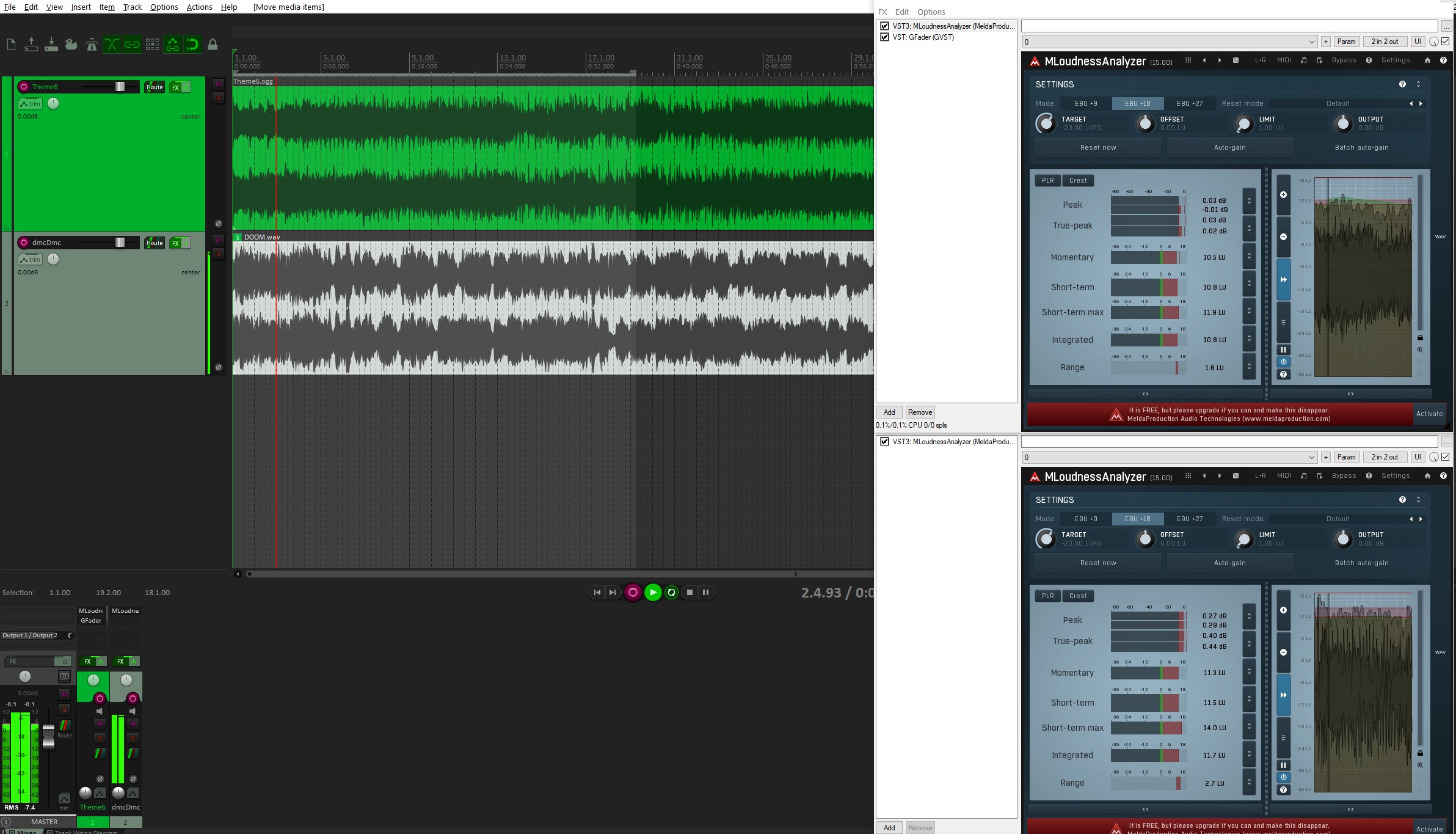
DmC: DMC is where I start to consider games reaching "loud". With a bumping soundtrack by Combichrist - an Industrial Metal band - and Noisia - an EDM and dubstep artist - and high octane action, it's understandable this game tends to be noisier than the previous games we checked. But how much so?
Well would ya look at that wave form! There is quite a range between the peaks.
The short term average is 8.8 LUFs, just under 2LUFs quieter than Theme6, which to me seems about right. The game is still loud, but without making you jettison you into orbit when the game is launched.
The max peak is just quieter than Theme6, but pretty close, and we can see that it has ever so slightly wider dynamic range than Theme6 as well.
In my humble opinion, this is sort of a golden area for the mix. It's loud, giving the excitement and fun that comes with loud mixes, but still dynamic enough to be expressive and punchy.
The short term average is 8.8 LUFs, just under 2LUFs quieter than Theme6, which to me seems about right. The game is still loud, but without making you jettison you into orbit when the game is launched.
The max peak is just quieter than Theme6, but pretty close, and we can see that it has ever so slightly wider dynamic range than Theme6 as well.
In my humble opinion, this is sort of a golden area for the mix. It's loud, giving the excitement and fun that comes with loud mixes, but still dynamic enough to be expressive and punchy.
5. Warframe - Digital Extremes, Evolution Engine
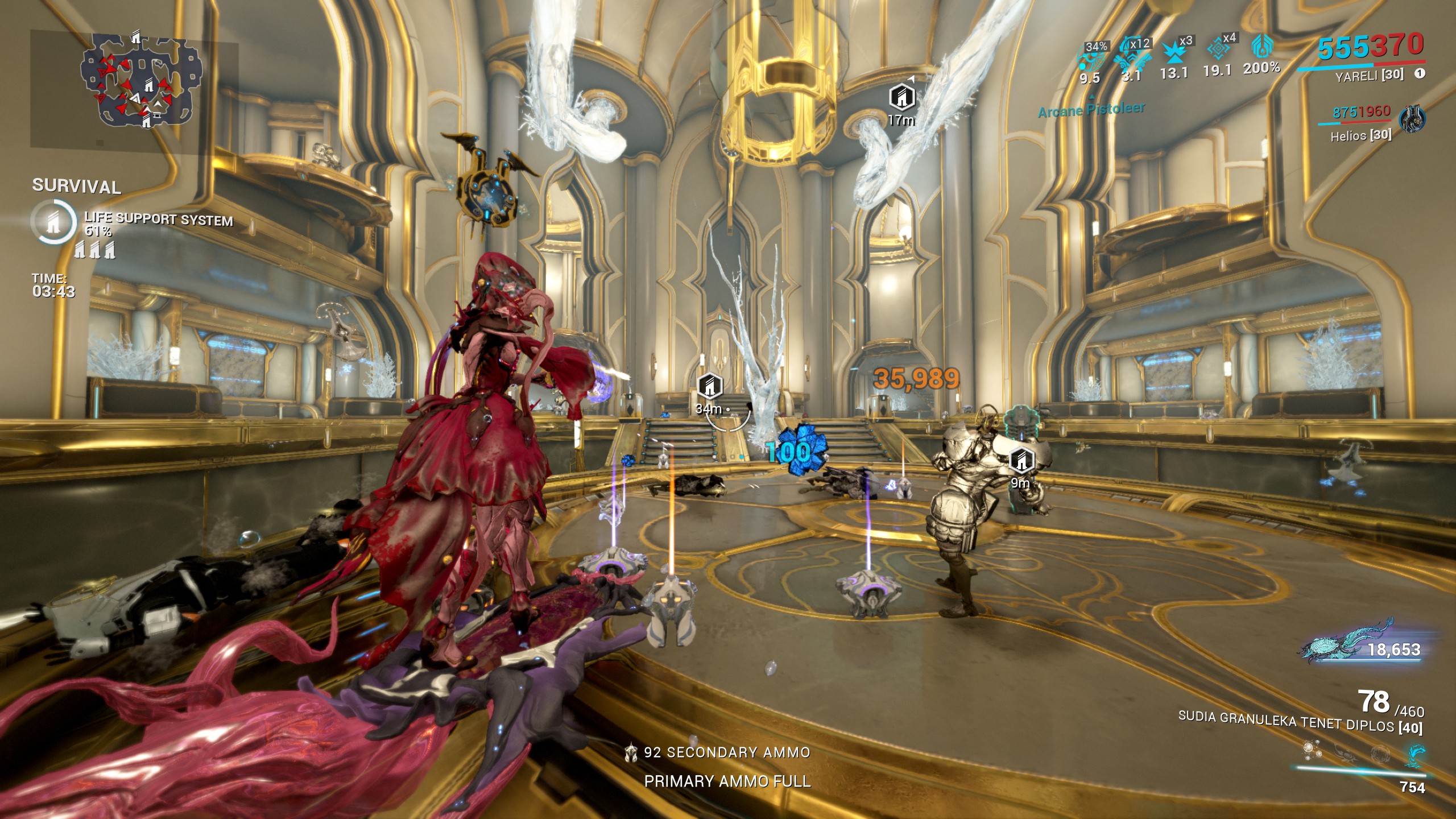
Warframe is another interesting one because, prior to testing, I sort of assumed it would be a much quieter game...and then I saw the measurements. You'll see that in just a sec. But what I think this goes to show is that loudness doesn't account for everything. Just because you have dynamics and your audio isn't super loud, doesn't mean it's still not going to be uncomfortable for people to listen to.
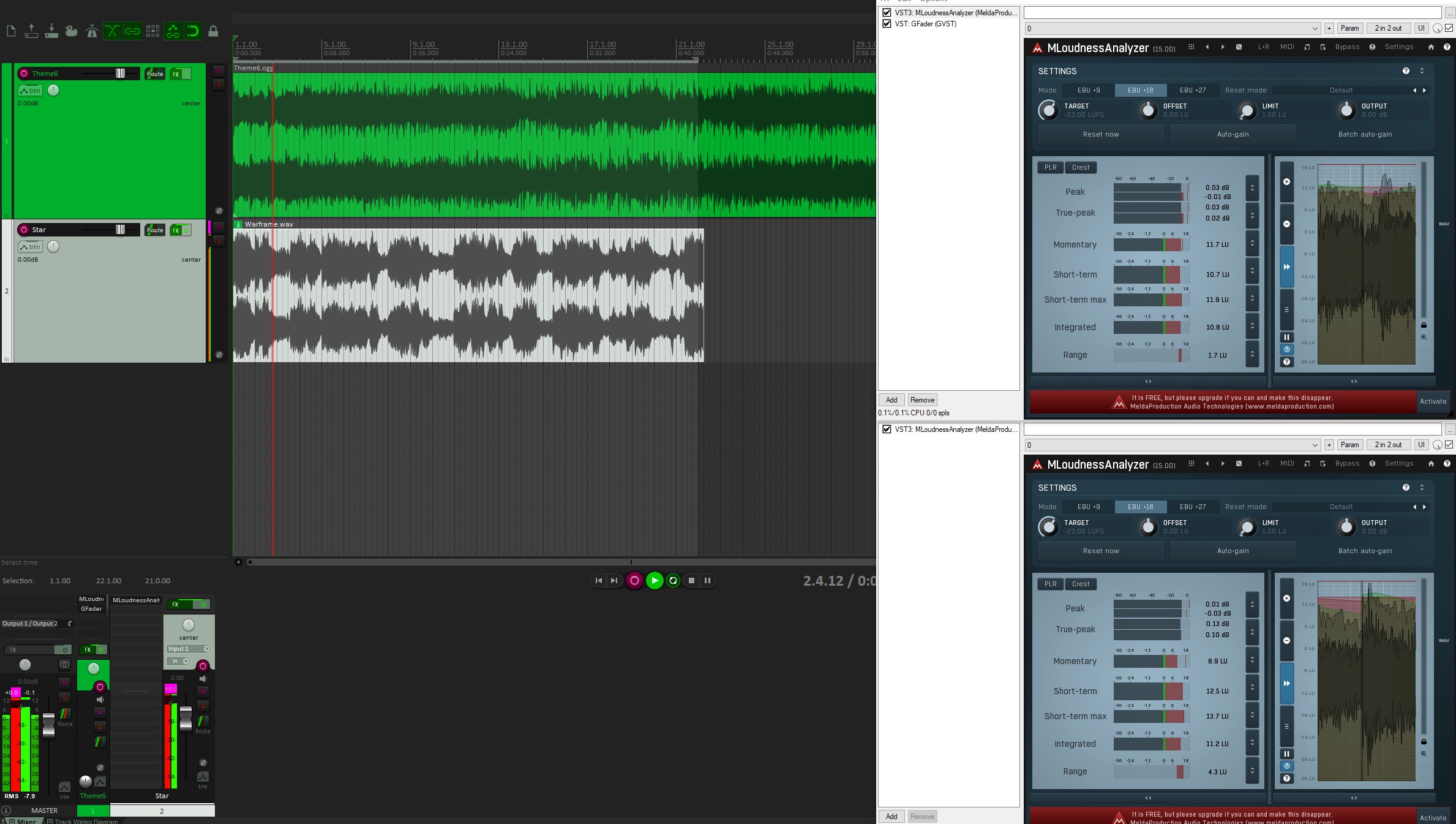
The game is really loud, with a short term of 12.5 LUFs, it is actually 2 LUFs louder than Theme6, but a more interesting story gets painted when you check the range. At 4.2 LUFs, it has a wider dynamic range than Theme6, and we can see this in the wave form, where the audio seems to go in bursts of loud and quiet.
The sound design in Warframe is aces, by the way. The artistry and sound work in this game are some top tier work, so it's no surprise that, despite the audio being much louder than RM, I find it far more enjoyable.
Points docked for the clipping though.
The sound design in Warframe is aces, by the way. The artistry and sound work in this game are some top tier work, so it's no surprise that, despite the audio being much louder than RM, I find it far more enjoyable.
Points docked for the clipping though.
6. DOOM: Eternal - id Software, id Tech 7 engine
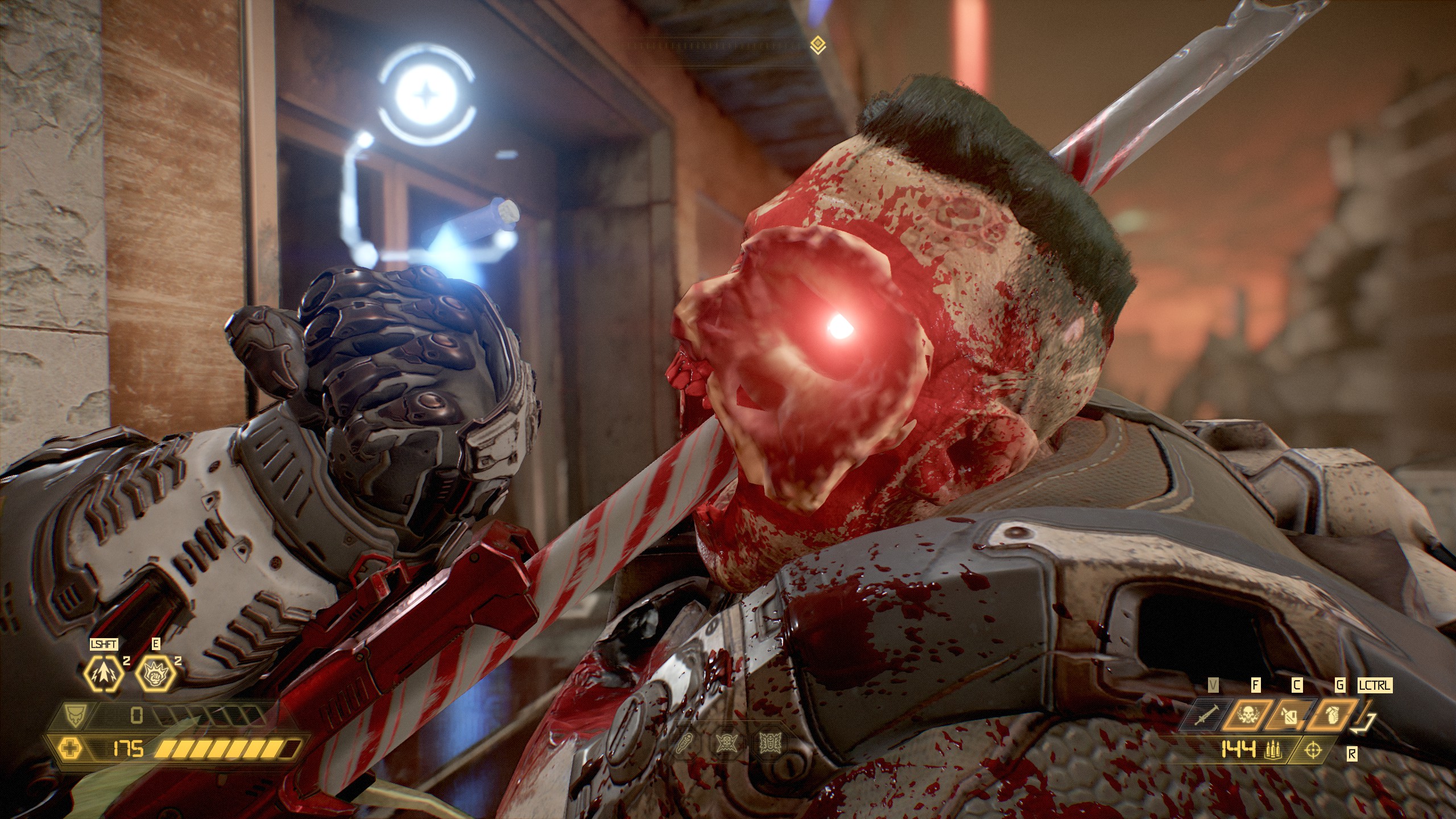
DOOM shares a similar picture as Warframe, in that the game is actually louder than Theme6, but is far more comfortable to listen to. Part this has to do with sidechaining the different audio channels to help make the overall mix feel tighter, and without having audio track fight for the same headroom.
What is side-chaining you ask? Well, it's when you use the output of one audio track to control the effect on another audio track. Most commonly this is used on compressors where the gain reduction is controlled by a separate input. The result is that the audio "ducks" out of the way when that other audio track reaches a certain volume. So in a way, audio track A is "clearing the way" for audio track B so that track B can be more audible.
Both Warframe and DOOM utilize a lot of sidechained audio in their mixes. This allows you to create a fake sense of "dynamics" by reducing the volume of another thing so that another thing can cut through the audio mix, it makes that other thing seem louder than it is, without actually making it loud.
7. Virgo Versus The Zodiac - Moonana, Game Maker
OOOOOOF, this game. Compression at maximum, dynamic range at 0. I picked this game because I distinctly remember really hating the mixing on an individual level of the soundtrack music, but also broadly speaking for the whole game as well. There also plenty of other reasons I really despised this game. But I'm not here to review games, just here to talk about loudness comparisons.
Hopefully after looking at so many volume comparisons throughout this section, you immediately notice something is a bit off here. Even if you aren't musically trained, you notice that there appears to be a long brick wall going through the wave form. The soundtrack to this game has been so overly compressed that it feels like it's right in front of your face screaming at you. It is an exhausting thing to listen to.
And the loudness measurements go to show that. at 11.9 LUFs, it is louder than Theme6, but it is far, far more exhausting to listen to than Theme6.
Also, major clipping problems from this game.
It's a real shame, because the CG art and illustrations really sold me on a different impression of the game that made me really want to like this game, but beyond the horrendous mixing, there are a number of fundamental flaws with the game design itself. Again, not here to review though.
8. Stardrop - Gumdrop Studio, Unity Engine
sorry, forgot to take screenshots of this one.
The game is a small indie project released for free on Steam recently. The reason I picked this game was...well it was convenient. I had already installed it because I was going to play this game on stream.
So, I applaud the solo effort, but this one is just here to go to show you: let's be thankful for the built in NWJS compressor.
Nearly every single sound in this game clips, which causes distortion, which causes fatigue on the ears, making it an exhausting listen...almost as much as Virgo.
Out of all games featured here, it has had the loudest peak in the short-term max, at 17.2 LUFs. Yeesh.
Conclusion to this chapter
The question of "what makes one consider RM to be louder than others" turned out to be interesting. We all operated under the assumption that RM games tend to be the loudest, but actually, what this has shown is that there is often quite the range in volume.As we progress through my exploration of the topic question, I think the thing to keep in mind going forward is that loudness doesn't paint the whole picture. With examples like DOOM and Warframe both being louder than RM, but afaik, there are no common complaints about the volumes of these games.
TEST 2, Loudness Comparison
Because of the strange -6dB in gap in volume between the game audio and the ogg audio I became skeptical of my recording set up, so I checked all my sliders and settings, found the culprit and tried it again.
Here, we can see the green track is the captured audio from the game, while the blue track is the raw ogg file.
While there is some difference, it's hardly conclusive. We are starting to get some sort of a picture that something is happening to the game audio though. Additionally, while it might be hard to see, there are some minor difference in the peaks in the wave forms.
To be honest, I don't work with LUFs much, so I am not as familiar with this measurement system, so I decided to move it to a measurement scale I am more familiar with, even if LUFs are the better way to measure perceived volume.
I set up my limiters on each individual track. Once again, the game audio is the top, the ogg audio is the bottom.
We can see a more interesting picture getting painted here.
Do you notice the red square on the volume meters for the ogg version? This indicates that the song clips. The red light will stay on until I reset the measurements. So you may notice that the game audio doesn't have the red light. This further proves that there is in fact some form of compression happening within the engine which is helping to prevent audio clipping and thus distortion at an engine level (this won't prevent distortion that has been baked into the song, but at least the engine isn't the cause of it.)
Next, we can look at the measured volumes. Just above the volume meters you'll see numbers for the peak volume and the RMS (root mean square) volume of the song. You'll notice there is roughly a -1dB difference in volume between the two versions, once again proving that there is a compressor being applied.
I guess what this just proves is that the musicians and sound engineer working in RM are working with black magic to have a song so loud yet still retain quite a bit of dynamics...or are they...?
How about a couple more fun audio tests...
Things Could Be Much Louder...
For another silly side quest, I wanted to compare Theme6's loudness compared to a song deliberately mixed to be loud. This is hardly scientific, but I think shows that sh/t can get a lot louder.
(Narcissistic Cannibal can be heard here)
Here I am comparing Korn's Narcissistic Cannibal's loudness to Theme6. Theme6 is on the top.
You can see that Korn is roughly 4 LUFs louder than Theme6, which is quite the difference.
You can also see that the wave form is far more square in shape than Theme6; there are less peaks and valleys in Narcissistic Cannibal when compared to Theme6. This is because the song has been deliberately mixed to be loud; and that is a whole debate sound engineers argue about which is called "The Loudness War". Evere since digital processing became ubiquitous the war began on who can make the loudest song.
Side Quest 2, Loudness Isn't a Bad Thing
Unrelated, but more people think no dynamics at all is bad (such as Korn's square wave song), but if the song is mixed for it, and the genre fits this type of mixing, I believe it can be a really fun and exciting way to mix audio. Thus you'll find a lot of my own music is quite square as well.
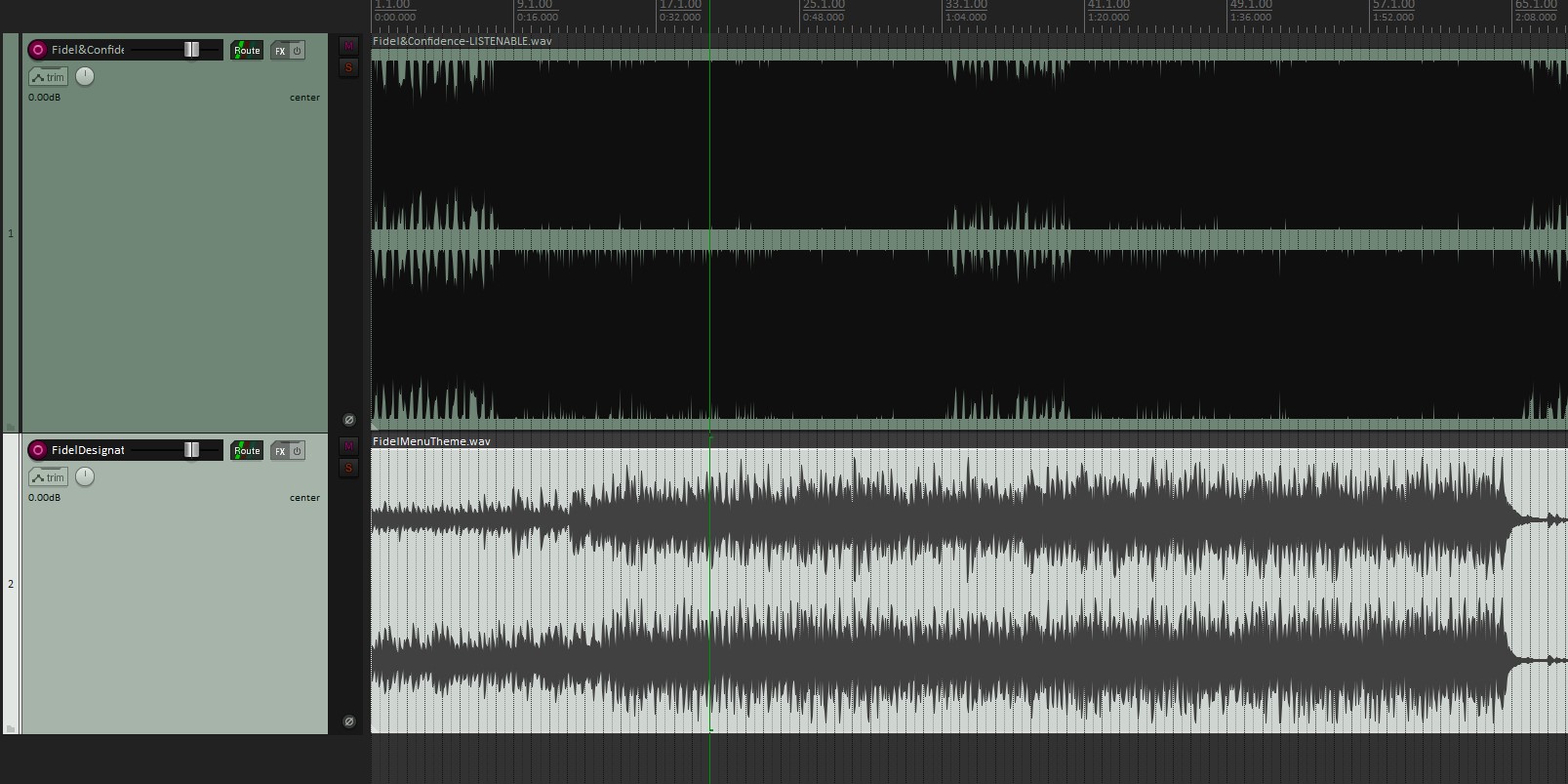
Here you can see my own wave forms. The top is an EDM, high intensity song and is quite square. However the bottom is a jazzy and much gentler song so I mixed it so that the dynamics can breathe.
Just tools in the toolbox.
Here you can see my own wave forms. The top is an EDM, high intensity song and is quite square. However the bottom is a jazzy and much gentler song so I mixed it so that the dynamics can breathe.
Just tools in the toolbox.
Things could also be much quieter...
So Korn gives us some perspective on a song that has been mixed intentionally to be loud. Well, out of curiosity, what if we take a more dynamic song that hasn't been as compressed and see what happens if we put that into the engine.
Let's take The Cinematic Orchestra's "Everyday"
I converted this song to an ogg and set it as the title menu theme for an RM project at the same volume setting as Theme6 is.
Once again, game version is on top, raw version is on bottom.
To me, I actually find this one more interesting. Although the compressor is reacting more or less the same, due to the song being far more dynamic, you can see a notable difference between the two in their peaks. Many of the peaks on the raw version (blue track) almost lick the top of the track. Meanwhile, you can see the game version doesn't quite reach the top of the track, showing the compressor in action.
An interesting thing to note is that, I thought I heard a slightly different EQ between these 2 versions. It could be my ears, it could be some sort of auditory illusion, but it seemed that the bass had been slightly rolled off in the game version, making some of the trebles ever so slightly harsher. And when I mean ever so slightly, like I debated whether it is actually there or not.
I tried to record an EQ for both tracks and then overlayed the EQs on top of each other to check for differences, but as far as my recording when, there was no perceptible difference between the 2 tracks...which is why I am second-guessing my ears.
Audio Subtraction: What's the Difference?
Now, as a final piece of measurement, here I wanted to check the difference between the game audio and the ogg audio.This is accomplished through phase inversion.
If you aren't aware what that is: if a positive wave meets a negative wave, they cancel each other out, right? The same idea applies in audio, where if 2 similar audio waves collide, they cancel each other out. This is actually how the active noise canceling in headphones works, by generating an equal but opposite wave from the sounds being heard by the microphones mounted on the headphone.
So, I inverted the phase of the game audio and played it at the exact same time as the ogg audio. The result is that any differences between the 2 versions will be heard, while anything that is exactly the same will cancel each other out.
It seems like there is quite a difference, unfortunately this data is somewhat bunk. This is due to the imprecise nature of how I had to handle this.
See, the game audio was just audio recorded directly from my desktop's output. The result is that there was a few milliseconds of silence at the start of the recording which had to be trimmed manually, then I had to manually sync the game audio as accurately as possible with the ogg audio. The further out of sync the audio is, the less precise this phase inversion method is going to be.
So, what does this tell us? Well, not much, more than likely. I think we can assume there are some minor differences between the 2 versions, but they'd likely be less perceptible than this.
As a bonus, we need to have a control group right? So just to prove to you what happens when 2 phases collide, here I have 2 copies of the Theme6 ogg file. They are both is perfect, absolute sync with each other (because they are identical files). One version of Theme6 has had its phase inverted. Here is the result:
Your speakers aren't broken. The result is that there is only silence, because you are basically taking 1 and -1 and adding them together, resulting in 0.
Applying What We Learned: A Remix that doesn't Kill Ears.
So, as discussed in the "Getting a base line" section of this article, it turns out that loudness doesn't really paint the whole picture, but in addition to loudness, mixing also plays a huge factor.
I did some investigating into the sample rate and kbps as well as other mixing techniques potentially used, but let's say not much stood out.
I will talk about some general mixing practices I dislike and one that I think contributes to the fatigue, but let's just here this more mellow mix I did:
Basically, it seems that the original mix, in general was loud in all parts of the spectrum, but I think the biggest offenders were the trebles and mids which make up the bulk of ear fatigue.
In most mixing circumstances, songs are mixed in what's called a V. The V mix is because the mids are dropped and the bass and trebles are raised. Depending on the type of song, this V can be excessive to mild, but generally speaking, every instrument has some sort of "mids" in them, and so all the instruments tend to bunch of in the mids causing excess muddiness.
With just a minor -2db reduction in the low mids, this cleared things up a lot.
I also targetted the trebles in making them less harsh by using a dynamic EQ, among other mixing techniques.
Let's look at the final result:
The wave form looks like this:
and the loudness looks like this:
(Since the remix is based on the ogg version in the game, the top graphs are loaded before all other effects, while the bottom graphs are loaded on the master bus [after all the effects])
So What Does Any Of This Mean?
Well, I wish I had some sort of interesting discovery to share with you. Actually, like I said before, Caethyril was already aware of the compressor, so it's not like that was a new discovery.
We didn't find out why the engine is perceived to be so loud either.
I found this testing interesting, but the end result is that all this testing sort of lead to no where, but maybe the information is valuable to you. Perhaps you learned something along the way. I spent the time doing all the data gathering, I figured why not share it, even if nothing new was discovered today.
I do think there is something funny going on with the audio engine of RM, but I think it would take more than just comparing wave forms.
for example, the loudness curve on the volume sliders is strange, where there is not much of a perceptible difference in volume going down from 100 to 70. 70 to 50 is only minor, and starting under 50 starts to make the biggest difference in volume.
I would need someone smart to look into what could be happening there, but that's not what this topic is about.
Sorry there is no super cool discovery at the end of this, but I hope you learned something today!
EDIT:
HUGE CONTENT DROP! FREE DOUBLE XP WEEKEND GOING ON NOW!
Added:
- Getting baseline; comparing other game volumes to Theme6
- Quiet songs; testing what happens to a less compressed/more dynamic song when put in the engine
- A SICKA/S R-R-R-REEEEEEEEEmmmIIXXXXXXXxXXxx *air-air-air-airhooorns*