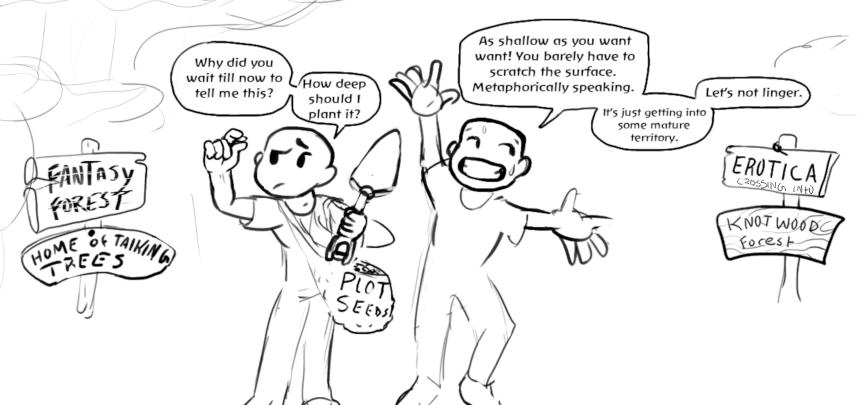
That's a rhetorical question. I'm going to tell you what it is. But I'd bet the answer is too simple and distasteful without proper context; and because I feel like writing I'm going to take the scenic route.
To begin, it's the name of a literary genre. That's what I want to talk about. Genres aren't proper nouns and shouldn't be capitalized, but for the purpose of this topic I'll be denoting the literary genre Fantasy with a capital F to help distinguish it from fantasy - an adjective. This is important because the word fantasy can have a lot of connotations and attribute different meanings, but Fantasy can not. Why? Because literary genres are nothing more than a classification for stories. Going outside what it is...well, outside of what it is. There can't be exceptions or alternatives of what the thing is. So Fantasy must do something that sets it apart from other stories in other literary genres.
Ok. So what does a story do? That's the question. When people ask what a story is about they're usually asking about the characters and setting and what makes it interesting. Those are components of a story; but what sets them apart into genres is how the story uses those things to do whatever it is it's doing.
If the story is teaching a lesson or moral to the reader it's classified as a Parable. A Fable does the same thing but uses animals and inanimate objects as characters instead of humans. Now, if you read the wikipedia articles you might get the idea that the 2 are distinguished by either having human or non-human characters. That's a difference, true, but it's not the difference. The events in a Parable are an analogy, while the characters in a Fable are a metaphor. So you can't simply substitute human and non-human characters to transform one genre into the other.
Then there's Science-Fiction in which the story speculates the use of technology or a study of practice. It doesn't have to be a legitimate science, the story only needs to focus on how it works and what the impact is on society or the environment. You've probably heard the old standing debate about Star Wars being Science-Fiction or Fantasy. Fyi, that discussion has been going on since before Star Wars evolved into a franchise, when it was just a movie trilogy. There's a lot of ways to look at it but I won't get into them. You have to realize that the literary genre Science-Fiction is different from the film genre Science-Fiction. They're 2 genres with the same name for different mediums that are doing different things.
There's Adventure novels, Adventure games, and Adventure films. Coincidentally, they all relate to an undertaking of some kind, hints "adventure". Different medium, Different context, different subjects: Story, Gameplay, and Cinematography. Presenting the audience with challenges to overcome or taking them to exotic locations justify the name adventure. It's an appropriate name and nothing more.
Getting to the point. What is Fantasy? A kind of story, but what? Before that, I want to take you "above the clouds" in a manner of speaking to gain perspective on English language. Looking down on what I just said "A kind of story" gives the wrong idea I think. And that figure of speech I used just now is also inappropriate. I literally tell you to "look down", but in reading top-to-bottom you'd actually need to look up. Chances are you knew what I meant. If you did you're in luck because that's an important skill in writing fantasy. Would you have understood it if I hadn't told you it was a figure of speaking? The problem with saying "a kind of story" is that Fantasy is not a story at all. It's a genre. A category. A shelf or compartment for a story to be placed in. We just went over that! I'm being very technical here because a quirk of informal speaking is a rampant use of synecdoches (See-neck-doo-keys). That's a greek word meaning "simultaneous understanding". It's when you refer to something by some other aspect of it. Like referring to athletes by their city, state, or country of origin. "Silver City took first place." Places are not people and can't actually win anything. And water is wet. I know, that's painfully obvious and that's because taking it literally would be nonsense. Or would it? Hmmm.
Anyways the point I'm making is that the language is misleading and creates a false sense of identity. If the story was a tree, it wouldn't matter how high it reached, how colorful it's leaves are. All trees have those attributes. The genre is more fundamental than that, the trees grows out of it and not the other way around. In this, the ground that the tree is on would be the genre. In fact you might even see the same story in different genres. When you think about it a story can overlap into different genres. It's the plot of land. Or just a "plot". See what I did? I was being literal and figurative. That sounds like a pun, but think of it as a seed. Naturally, seeds are pun-y compared the thing they grow into. Get it? The joke?? I know, it doesn't work phonically.
I've been guiding you through all this because it's a fundamental understanding that requires your feet on the ground, despite wherever your head might be at. You're probably aware that once you know how a magic trick works you lose the wonder of it. Are you sure you want to know the simple truth that all Fantasy stories have in common? You might have started with castles in the sky, then stepped down to taste fruit from a monolithic tree of life, and at the bottom descended down a rabbit hole, expecting to find next the fires of hell or a lost world.
But the reality of what's there is just plain ordinary terra firma. But I'm not going to tell you to eat dirt.
A story that fits into the Fantasy genre imagines the figurative in a literal sense.
Spoiler
I'm pretty sure I've seen this joke somewhere before.