First floor
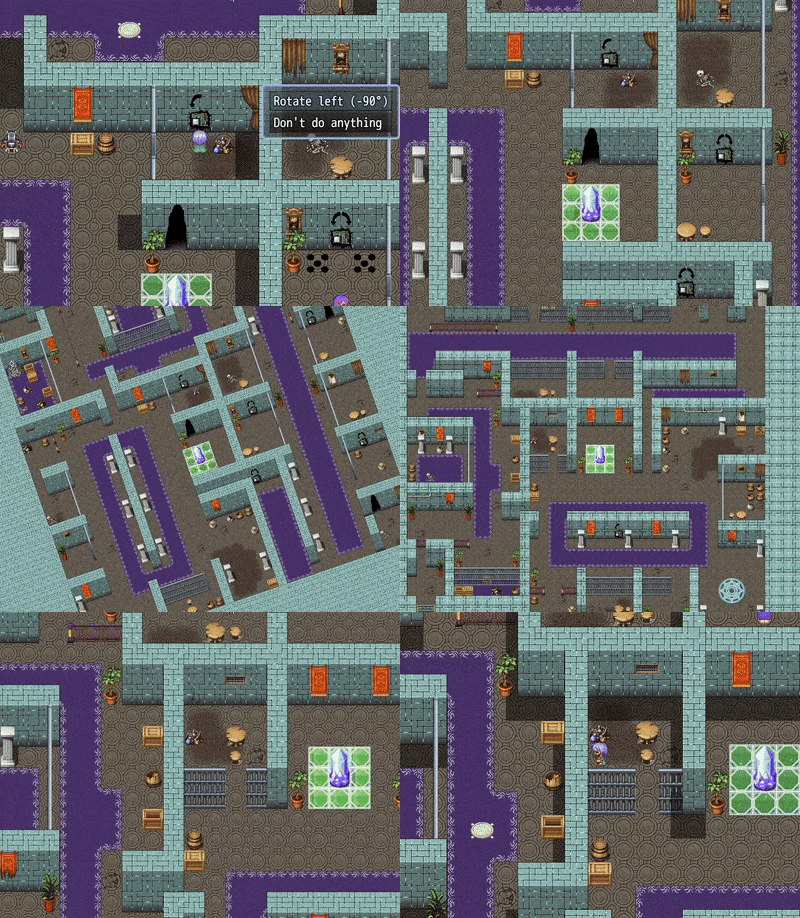
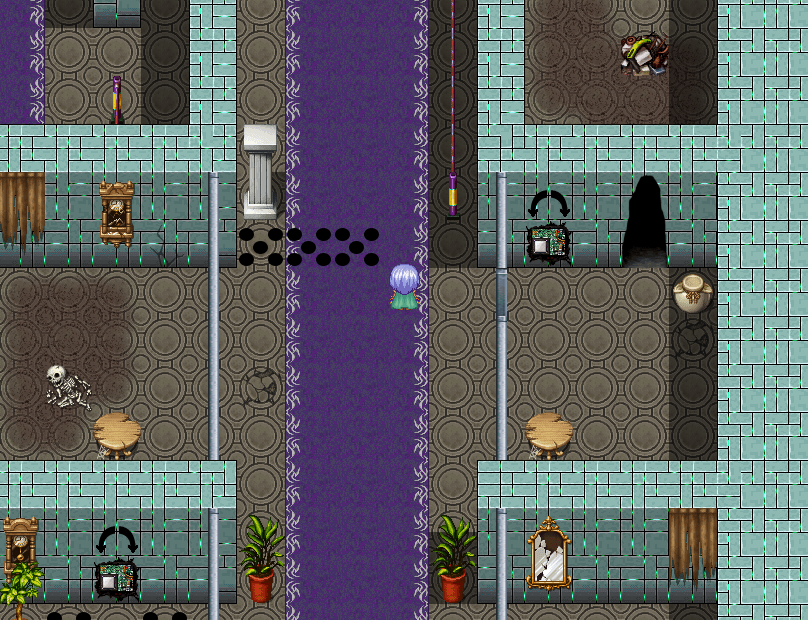
The very first room was a good introduction to the central mechanic. I didn't have to do much thinking, just trying out each rotation and seeing what it made available, but this allowed me to easily grasp what exactly was rotation doing.
And that one-way gap in a wall was a great way to really hammer in the concept of "you can only interact with things you can see".
The shadows are also really helpful for keeping your bearings through the rotations.
I'm not what's the reason for disabling the menu the entire time. I get that you only want the player to save at checkpoints, but that can rather easily be disabled separately. And being able to turn auto-run on would be really nice.
The second area was were some of the frustrating parts started, namely not knowing that's where. It took a considerable amount of time to just understand what the puzzle
is, by trying out various rotations and checking what's on each wall. I felt a lot like just trial an error, and I had to keep quite a lot of elements in my head, because I couldn't see them.
A larger field of view (or maybe an ability to zoom out), and an ability to tell where switches are (like on the last level) would have greatly helped here.
Once I actually understood what the puzzle is (get the ship into
this rotation with
these spikes being off with me somewhere in
this area) it wasn't so bad.
Though it was kind of funny how after I used the last switch that would get everything into the right state (the one in the south-west corner), I ended up in a room with the exist I was planning to take blocked. I probably should have seen that coming, but back then I still haven't built up an intuition for how the walls will end up after rotation.
But I was saved but a one-way passage I didn't even know was there, so that worked out in the end
:p
Again, it would be nice if that information was a bit easier to obtain and remember, e.g. if a wall with a crack in it would also have some visible damage on top of it.
Once I got past the robots, breaking their "invincible formation" and going for the stairs in a different direction were rather simple.
I also think this hike in complexity from the first area might be too high. There are a lot of elements you need to keep in your mind, and I expect people who aren't puzzle game veterans might really struggle here. The whole "180° rotation to break spike parity" trick probably deserves a separate puzzle on it's own.
But on the other hand, designing a puzzle that's simpler while also not being easily brute-forced by hitting every switch you see might be quite a challenge.
Second floor
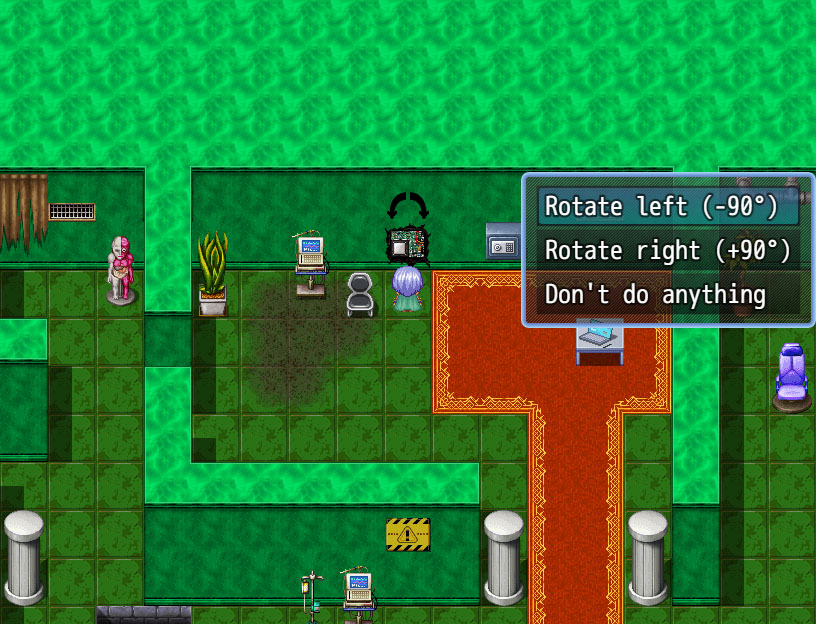
The green area was where I really started to think with
portals rotation. As in, trying to predict exactly how things will look like instead of just pressing buttons and seeing what happens. It's rather simple when you get used to it, making my confusion earlier looks quite funny.
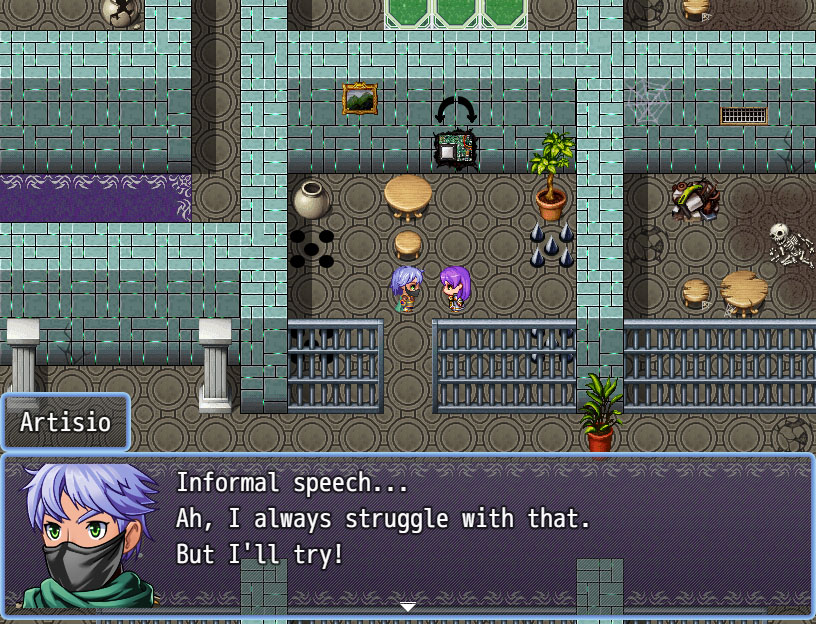
I also started thinking about these puzzles in a more formalised way. Since they are, effectively, a maze. There are 8 "worlds" - one for each combination of rotation and spikes state. Wall panels and the lever allow for travel between worlds. Each world is separated into multiple areas (by spikes or impassable walls), and each area includes multiple transfer points to different areas in other worlds (or sometimes only one, but then it's not a "branch", just a straight path through the maze). The challenge is to build up a mental map of what connects where, and to navigate it to reach various points. Or, more realistically, to explore the whole maze, since it's quite hard to get to all paintings without also getting to every other place too.
It was quite fun! Exploring this weird multidimensional maze was certainly a rather novel experience, but at the same time the mechanics made sure I mostly knew what to expect in other worlds.
Thought here I was once again wishing to be able to access more information at once - a larger field of view and some markings where the panels are would have made this a lot more pleasant.
Inversion sounds like a really interesting ability (especially if robots still keep their orientation, so there are differences in the reversed world). It's a shame we don't get to use it in the demo.
Though it would probably need some very good UI to support it, like a preview of where you'll end up after an inversion.
Third floor
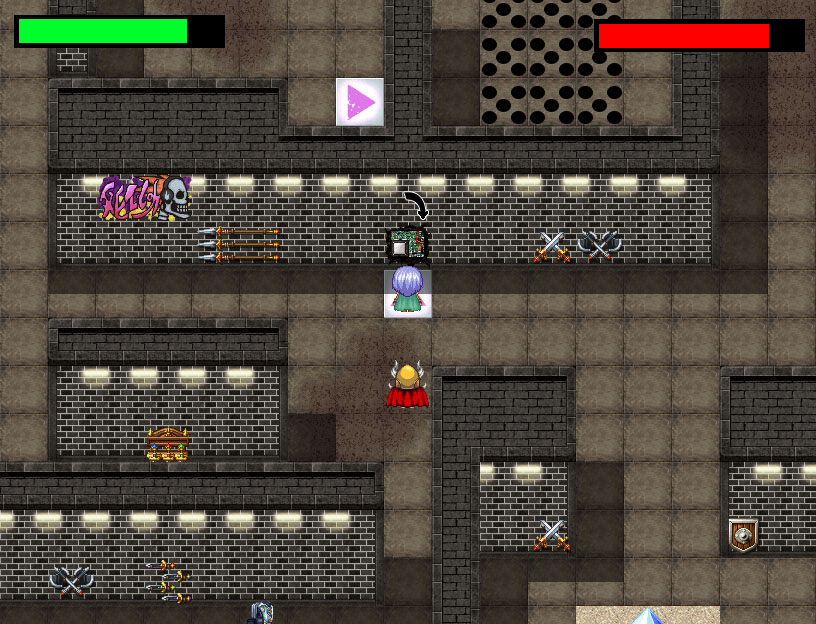
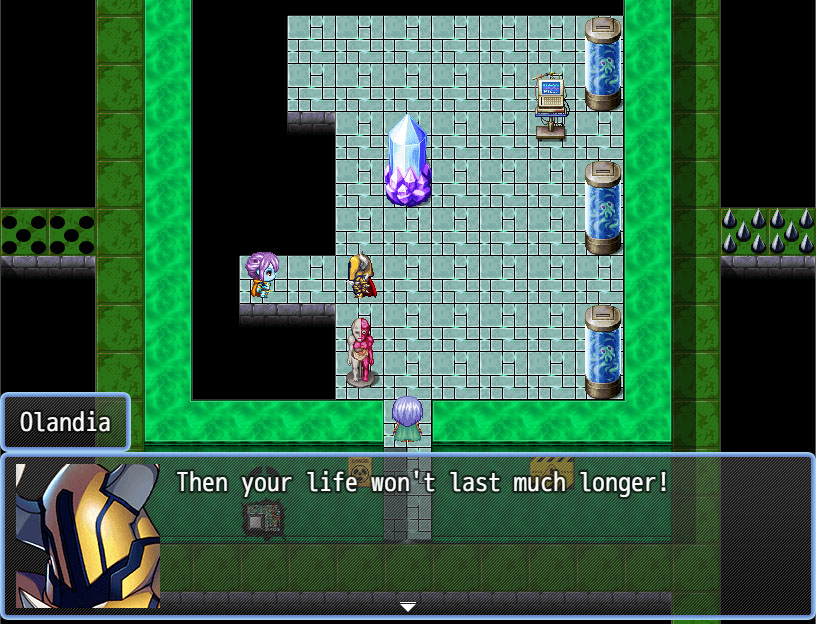
The final fight was quite fun! Took me a bit to figure out how to do it - I initially kept spinning around in search of the 180° rotation panel. Realising that of course you absolutely can get hurt by a 90° rotation too was a fun eureka moment. Though between that and some misses (too late realisation: if there's a wall on the right of the boss that doesn't mean they'll get hurt - they need to be near the
base of a wall) I think I ended up in a state where I no longer had enough switches to kill the boss completely. Not wanting to spend time to figure out if I'm right, I died intentionally and won the next
time. It was a fun fight! The arena had a lot of varied geometry that kept me thinking "how do I get them with
this one" each time. I particularly liked the field of spikes.
The credit crawl was really fast. Especially since it's quite short, it could definitely scroll much slower.
While I barely managed to read, the upside-down "Thanks for playing" definitely got a chuckle out of me.
... to think about it, I wonder if it was so fast because I'm on a 165Hz monitor an its speed is dependant on
Graphics.frameCount. If so, there's a very nice
plugin for fixing these kinds of issues
;)
Summary
Overall, I really enjoyed the game! There are definitely some improvements that would make it rely a bit less on memorising so many things, but the core concept is very solid.
Ideas
Of course there are plenty of things you could do to spice things up later on.
There's definitely potential for some devilish Sokoban puzzles with those shifting walls.
Or having to drive a large 2x2 vehicle through an area (maybe it's also somehow useful itself, or able to drive through spikes).
Having multiple crystals per level, where each panel only rotates a part of the entire level could be fun. Though I guess it might not fit with the theme of changing the vanishing point and look more like physical rotation.
Another type of barrier that changes together with spikes, but can be flipped with a separate level would be a rather simple addition, but allow for a considerable increase in complexity.
It hope you find some of this useful
:)